


U-40 vs U-100 Insulin Syringes: What Is the Difference?
This means U-100 insulin contains 2.5 times as many insulin units in the same liquid volume as U-40 insulin. The correct syringe therefore depends on the concentration stated on the insulin vial—not simply on the syringe’s physical size, needle gauge or appearance.
01 What Do U-40 and U-100 Mean?
The “U” refers to insulin units, while the number states how many units are contained in one milliliter:
The difference is concentration, not the syringe material or needle diameter. Dedicated insulin syringes account for the concentration difference through their printed unit scales. When the syringe matches the insulin concentration, the prescribed number of units can be read directly from the barrel without a separate volume conversion.
02 U-40 vs U-100 Insulin Syringes at a Glance
| Feature | U-40 Insulin Syringe | U-100 Insulin Syringe |
|---|---|---|
| Intended insulin concentration | 40 units/mL | 100 units/mL |
| Liquid volume per insulin unit | 0.025 mL | 0.010 mL |
| Concentration relationship | Lower concentration | 2.5 times the unit concentration of U-40 |
| Barrel scale | Calibrated for U-40 insulin | Calibrated for U-100 insulin |
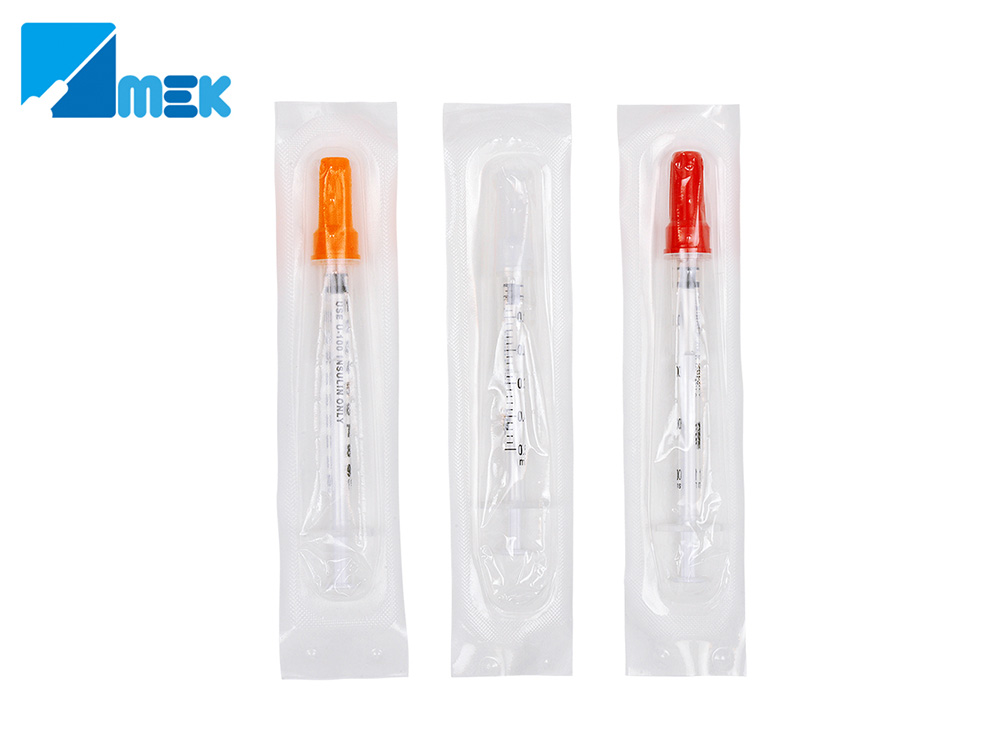
| Dedicated identification color under ISO 8537 | Red | Orange |
| Correct pairing | U-40 insulin | U-100 insulin |
| Interchangeable without professional instructions | No | No |
ISO 8537:2016 covers sterile, single-use insulin syringes intended for insulins of different concentrations. Red and orange provide fast visual differentiation for U-40 and U-100, but color should support—not replace—clear printed concentration identification on the syringe and packaging.
03 How Nominal Syringe Volume Relates to Insulin Units
Syringe capacity is expressed in milliliters, while insulin dosing is expressed in units. Because U-40 and U-100 contain different numbers of units per milliliter, the same nominal syringe volume corresponds to different unit capacities.
| Nominal Syringe Capacity | Units at Full Nominal Volume for U-40 | Units at Full Nominal Volume for U-100 |
|---|---|---|
| 0.3 mL | 12 units | 30 units |
| 0.5 mL | 20 units | 50 units |
| 1.0 mL | 40 units | 100 units |
These figures show the mathematical relationship between nominal volume and insulin concentration. The actual graduation interval, numbering pattern and labeled capacity must be confirmed for each product model and target market. For procurement teams, “0.3 mL, 0.5 mL or 1 mL” is therefore not a complete specification; the requirement should also state U-40 or U-100, the smallest graduation interval, the numbering frequency and the applicable tolerance.
04 Why the Printed Scale Matters More Than Physical Appearance
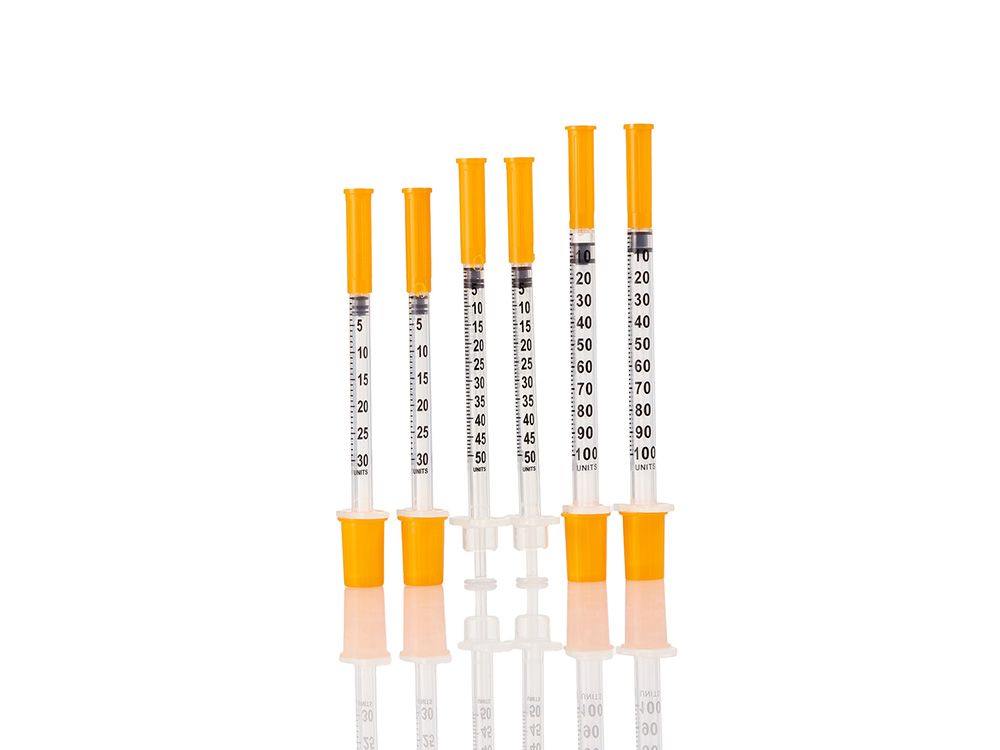
A U-40 syringe and a U-100 syringe can have a similar barrel length, needle size and general construction. Their most important functional difference is the relationship between the printed scale and the insulin concentration.
If the wrong syringe scale is used, the indicated units no longer match the actual units. Because the two concentrations differ by a factor of 2.5, a mismatch can result in significant over- or underdosing. Buyers should therefore evaluate the syringe as a complete measurement and identification system: barrel clarity, graduation accuracy, number placement, ink contrast, concentration marking and protective-cap color all contribute to reliable identification.
05 Does Needle Gauge Determine U-40 or U-100?
No. Needle gauge and insulin concentration are separate specifications. The gauge describes the needle’s outside diameter: a higher gauge number generally indicates a finer needle. Needle length, bevel geometry, wall thickness and silicone lubrication can influence penetration and flow performance, but none of these features changes whether the barrel is calibrated for U-40 or U-100 insulin.
Mekon standard and safety insulin syringes are available in 0.3 mL, 0.5 mL and 1 mL capacities, with needle gauge options from 27G to 31G. The concentration, capacity, needle gauge and needle length should be confirmed independently for every project.
06 Standard vs Safety Insulin Syringes
The U-40/U-100 distinction applies to both conventional insulin syringes and safety insulin syringes. A standard single-use insulin syringe focuses on direct dose measurement and administration. A safety insulin syringe adds a protective function intended to reduce exposure to the needle after use.
Mekon’s safety configuration uses a pull-and-twist shielding mechanism and a securely attached stainless steel needle. Whether the selected design is standard or safety, the concentration-specific scale remains essential. Safety activation, locking and shielding performance should be evaluated separately from scale accuracy and concentration identification.
Buyers can review Mekon’s standard insulin syringe and safety insulin syringe configurations for additional product details.

07 What Should Buyers Check Before Ordering?
08 Quality Control and OEM Configuration
An insulin syringe specification should address more than appearance. The final inspection plan and acceptance criteria should be agreed before mass production, particularly when the barrel artwork, unit scale, color identification or safety configuration is customized.
Product and quality controls
- Graduation accuracy and scale legibility
- Barrel transparency and visible cleanliness
- Plunger movement, sealing and leakage performance
- Needle attachment, tip condition and dimensions
- Safety activation and locking, where applicable
- Sterility and package-integrity requirements
OEM information to confirm
- U-40 or U-100 concentration and unit scale
- 0.3 mL, 0.5 mL or 1 mL capacity
- Needle gauge, length and wall specification
- Standard or safety configuration
- Color reference, printing and label language
- Packaging layout and traceability information
Mekon offers U-40 and U-100 insulin syringe configurations in multiple capacities and needle gauges. Available product features include a clear barrel, bold scale markings, lubricated needles, individual sterile packaging and latex-free construction. OEM branding and packaging requirements can be discussed according to the complete target specification and market.
09 Frequently Asked Questions
Is U-100 simply a larger U-40 syringe?
No. U-40 and U-100 describe the insulin concentration for which the syringe scale is calibrated. Either type may be offered in different physical capacities.
Can a U-40 syringe be used with U-100 insulin?
They should not be treated as interchangeable. Always match the syringe to the insulin label and follow qualified professional instructions.
What colors identify U-40 and U-100?
ISO 8537 assigns red to U-40 and orange to U-100. Printed concentration identification remains necessary because color should not be the only safeguard.
Does a 1 mL syringe always correspond to 100 units?
No. A 1 mL U-100 syringe corresponds to 100 units, while a 1 mL U-40 syringe corresponds to 40 units.
Does needle gauge define the insulin concentration?
No. Gauge describes the needle diameter. Concentration, barrel capacity, needle gauge and needle length must be specified independently.
What should be included in an OEM inquiry?
Include concentration, capacity, graduation interval, needle gauge and length, standard or safety design, packaging, label language and target market.