


Needle Gauge Chart: How OD, ID and Wall Thickness Affect Performance
01 What Does Needle Gauge Mean?
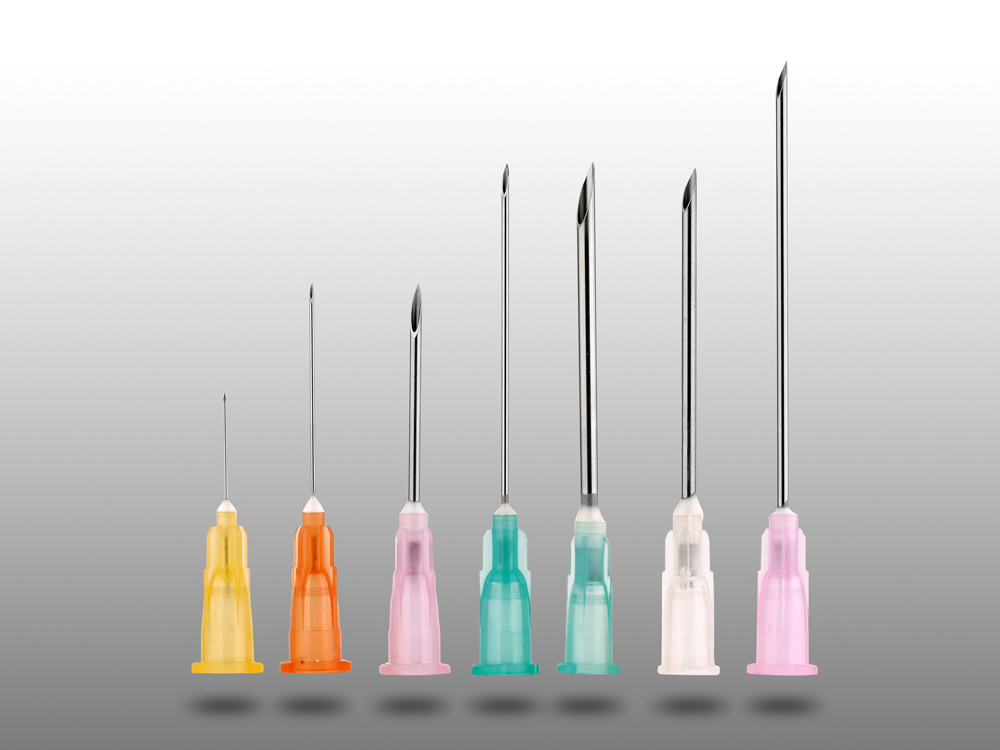
Needle gauge is a conventional size designation used to describe needle tubing. In the medical needle range, the relationship is inverse: as the gauge number increases, the designated outside diameter becomes smaller. For example, an 18G needle has a larger OD than a 25G needle.
Gauge should be treated as a convenient size label rather than a complete engineering dimension. A purchasing specification should still state the metric OD and tolerance required by the drawing or applicable standard. This is especially important for custom cannulas, microinjection needles, flexible tubing and sizes outside the standard medical range.
ISO 9626:2016 specifies dimensions and mechanical-property requirements for rigid stainless steel needle tubing in designated metric sizes from 3.4 mm (10G) to 0.18 mm (34G). Sizes or constructions outside this scope should be defined through the supplier specification and approved drawing.
02 Needle Gauge to Millimeter Chart: 10G to 34G
The following chart lists the designated metric sizes specified in ISO 9626:2016. The millimeter value is the nominal outside-diameter designation—not a substitute for the standard's dimensional limits, the manufacturer's tolerance or the final product drawing.
| Gauge | Designated Nominal OD |
|---|---|
| 10G | 3.40 mm |
| 11G | 3.00 mm |
| 12G | 2.70 mm |
| 13G | 2.40 mm |
| 14G | 2.10 mm |
| 15G | 1.80 mm |
| 16G | 1.60 mm |
| 17G | 1.40 mm |
| 18G | 1.20 mm |
| 19G | 1.10 mm |
| 20G | 0.90 mm |
| 21G | 0.80 mm |
| Gauge | Designated Nominal OD |
|---|---|
| 22G | 0.70 mm |
| 23G | 0.60 mm |
| 24G | 0.55 mm |
| 25G | 0.50 mm |
| 26G | 0.45 mm |
| 27G | 0.40 mm |
| 28G | 0.36 mm |
| 29G | 0.33 mm |
| 30G | 0.30 mm |
| 31G | 0.25 mm |
| 32G | 0.23 mm |
| 33G | 0.20 mm |
| 34G | 0.18 mm |
03 OD, ID and Wall Thickness Are Three Different Values
For example, if a tube drawing specifies an OD of 0.90 mm and an ID of 0.60 mm, the nominal single-wall thickness is (0.90 − 0.60) ÷ 2 = 0.15 mm. The calculated nominal value does not replace dimensional tolerances: the allowed OD and ID ranges determine the actual minimum and maximum wall conditions.
04 RW, TW, ETW and UTW: Why the Same Gauge Can Have Different IDs
Needle tubing may be described as regular wall, thin wall, extra thin wall or ultra thin wall. These designations indicate progressively different wall constructions, but they should always be linked to the actual OD, ID and tolerances for the selected gauge.
A 21G RW needle and a 21G TW needle can share the same nominal OD while having different IDs. The TW version can provide a larger lumen without increasing the outside diameter. This can support flow requirements, but it does not automatically make TW or UTW the better choice: stiffness, buckling resistance, puncture geometry, length and intended use still need to be evaluated.

05 How ID, Length and Fluid Properties Affect Flow
For flow through a needle, ID is often more informative than gauge alone. In simplified laminar-flow theory, resistance changes strongly with the internal radius. A small increase in ID may therefore produce a meaningful change in flow resistance when the other conditions remain similar.
Actual performance can also be affected by pressure, temperature, fluid behavior, silicone lubrication, surface condition, bevel or outlet geometry and the connected syringe or delivery system. A gauge chart is therefore a starting point for selection—not a flow-rate guarantee.
06 Does a Higher Gauge Always Mean Better Performance?
No. A higher gauge means a smaller OD within the relevant gauge system, but “smaller” is not automatically “better.” The correct size depends on the intended device, target flow, fluid viscosity, working length, mechanical loads, tissue or access requirements, connection design and applicable verification.
Needle selection should therefore begin with the intended performance and risk requirements. Gauge, OD, ID, wall thickness and length are interconnected design variables, not a ranking from “worst” to “best.”
07 What Buyers Should Specify When Ordering Needle Tubing
For efficient sample development, buyers should provide a drawing, reference sample or complete dimensional table. For custom cannula projects, Mekon's engineering team can review gauge, OD, ID, wall type, material, length, tip processing, holes, markings, surface treatment and assembly requirements together.
08 Manufacturing and Inspection: From Drawing to Batch Control
Stable needle performance depends on transferring the approved dimensions into repeatable tube processing and finished-device inspection. OD, ID and wall thickness should have defined measurement methods, sampling plans or 100% controls where appropriate, and acceptance criteria linked to the drawing.
Tube and component controls
- OD, ID and calculated or measured wall condition
- Cut length, straightness and end condition
- Surface quality, cleanliness and burr control
- Hardness, stiffness or resistance-to-breakage requirements
- Tip, hole, notch or formed-end dimensions
- Traceability from raw tube to finished batch
Finished-needle controls
- Effective length and assembled position
- Tip geometry, sharpness and visible defects
- Hub fit, bonding and connection performance
- Flow, leakage or functional tests for the intended design
- Color, marking, labeling and packaging consistency
- Sterilization and package-integrity requirements
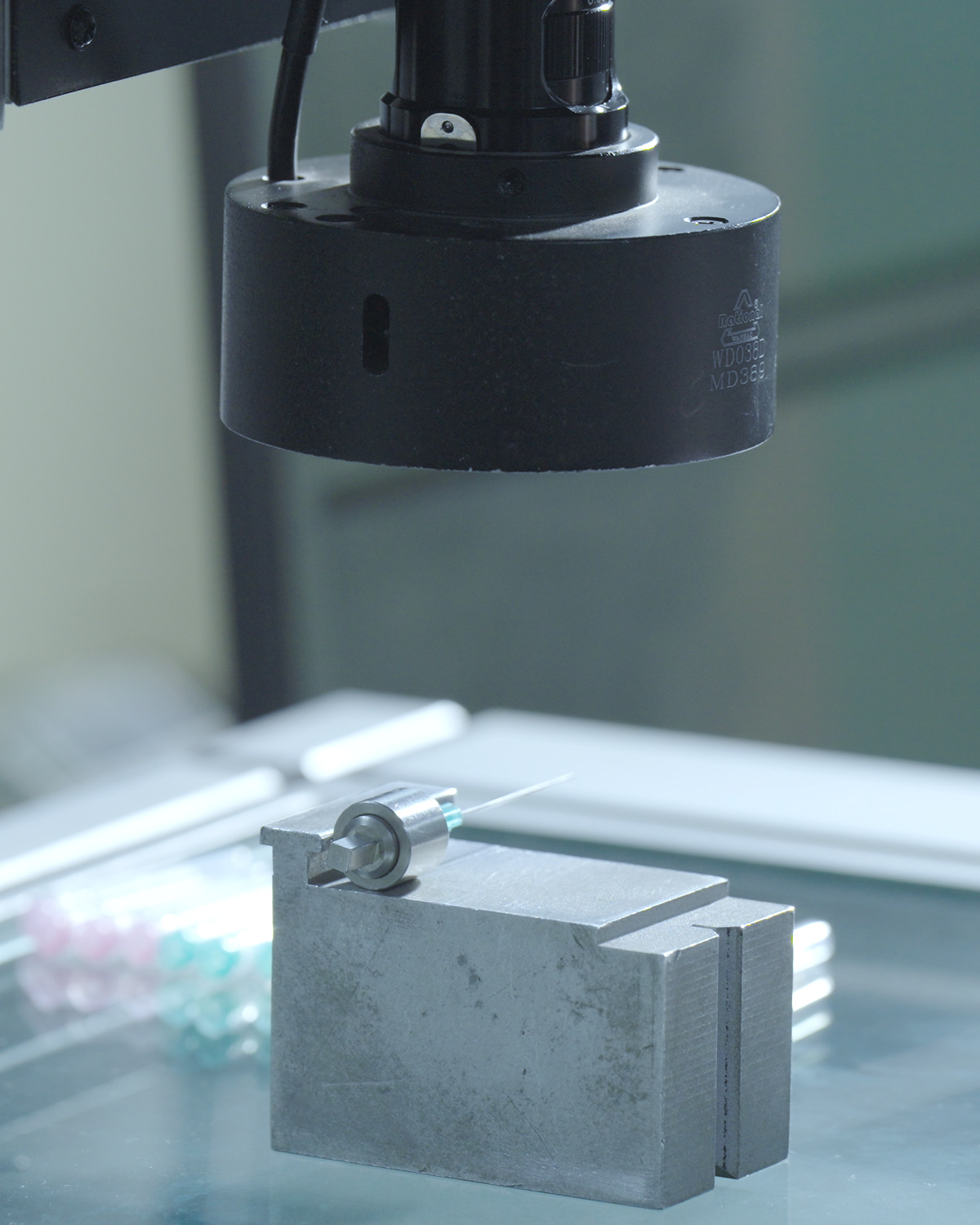
Optical measuring equipment, microscopes, gauges and application-specific fixtures may be used at different stages. The selected method should match the dimension being evaluated; for example, an OD check and an ID or cross-section assessment are not automatically the same inspection.
09 Frequently Asked Questions
Does a higher needle gauge mean a smaller needle?
Yes. Within the same gauge system, a higher gauge number generally corresponds to a smaller designated outside diameter.
Does gauge describe OD or ID?
Gauge is mainly associated with OD. ID depends on both OD and the selected wall construction, so it must be confirmed separately.
Can two 21G needles have different IDs?
Yes. A 21G RW and a 21G TW needle can have the same nominal OD but different IDs because the wall thickness is different.
How is needle wall thickness calculated?
Nominal single-wall thickness is calculated as (OD − ID) ÷ 2. Tolerances must be considered when evaluating actual minimum and maximum wall conditions.
Is 35G included in ISO 9626:2016?
No. The published standard covers 10G to 34G. For 35G and finer products, confirm the supplier-specific OD, ID, tolerances and test requirements.
Does hub color alone confirm the needle specification?
No. Color coding supports identification for applicable products, but the printed specification, packaging, drawing and product standard should also be checked.