Please leave a message.

Bone Marrow Biopsy Needle: Twist-Lock Handle, Depth Markings and Sampling Design

2026-09-23
Bone Marrow Sampling | Product Guide

A bone marrow biopsy needle works as a coordinated assembly. The handle, inner stylet, outer coring cannula, depth markings and specimen-removal accessories all contribute to controlled access and retrieval of an intact marrow core. Understanding how these parts relate is essential when comparing tip options or preparing an OEM specification.

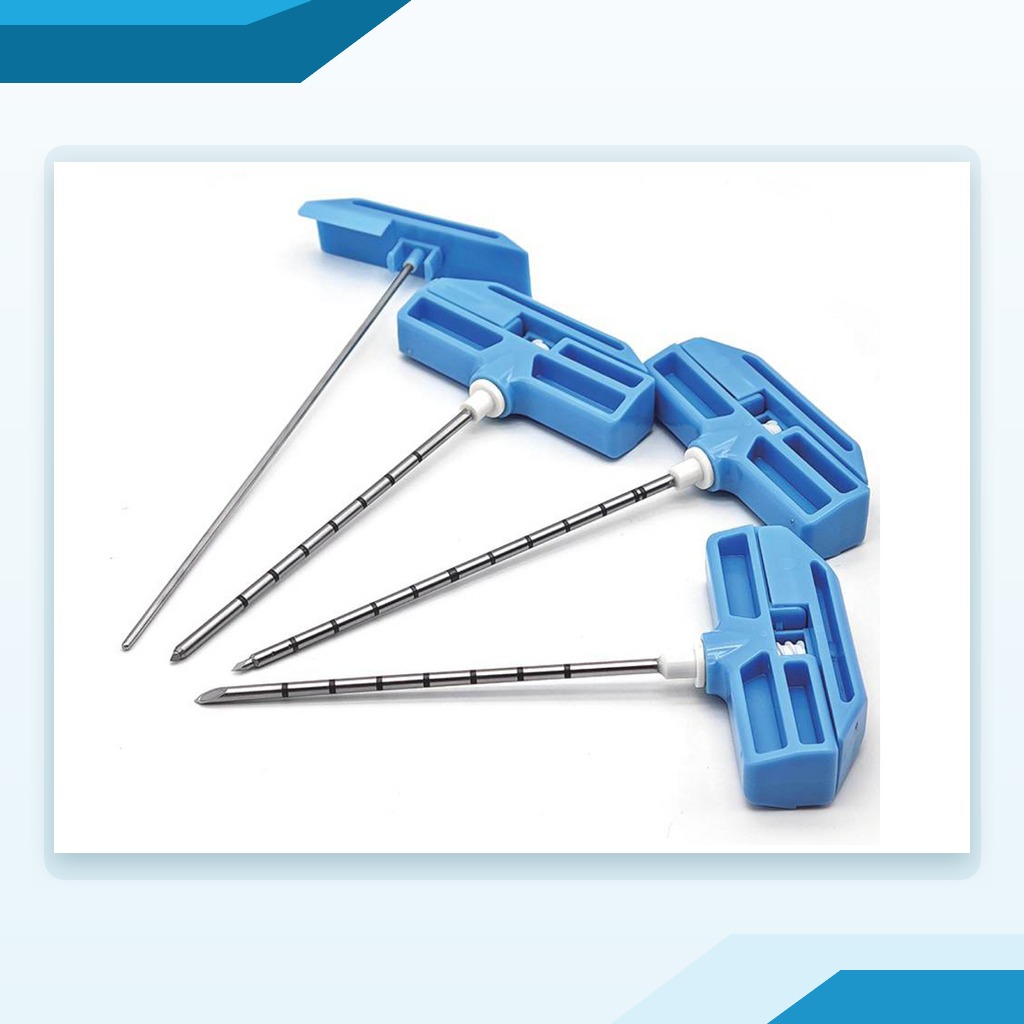
Mekon single-use bone marrow biopsy needle set
Mekon single-use bone marrow biopsy needle family. Final gauge, length, tip configuration and accessory set should be confirmed in the approved product specification.
Available gauges
8G, 11G, 13G
Confirm the required gauge for the selected configuration.
Available lengths
10, 12 and 15 cm
Other customized lengths may be evaluated.
Tip options
Sharp bevel or Diamond
Do not identify the inner and outer needles as two tip options.
Supply format
EO sterile, single use
Peel-open package with a stated five-year shelf life.
01

A Biopsy Needle Is a Coordinated Sampling System

The purpose of a core bone marrow biopsy is to obtain a cylindrical tissue specimen that preserves the architecture required for laboratory evaluation. The device must therefore support a sequence of connected functions: initial access, controlled advancement, core acquisition, withdrawal and specimen release.

These functions depend on the fit between the inner stylet and outer cannula, the distal cutting profile, the rigidity of the stainless-steel components and the operator's control through the handle. A product review should assess the complete assembly rather than judging one visible needle point in isolation.

Ergonomic handle: A broad twist-lock handle provides a stable surface for controlled rotational handling and helps reduce hand fatigue.
Inner stylet: The stylet occupies the cannula lumen during entry. Its distal geometry must align correctly with the outer cannula.
Outer coring cannula: The marked outer cannula creates the sampling path and captures the cylindrical tissue core.
Depth markings: Centimeter markings provide a visual reference for estimated penetration depth during use.
Luer-lock connection: The connection allows attachment to a syringe when aspiration is included in the selected configuration and procedure.
Extraction components: An extraction cannula and remover guide support controlled expulsion and inspection of the collected specimen.
02

How the Handle, Markings and Needle Assembly Support Control

Bone entry may require deliberate rotational movement rather than a simple straight push. The handle is therefore the main interface between the clinician and the needle assembly. Its shape, rigidity and connection to the metal components influence how predictably force can be applied.

Shaft markings complement this mechanical control by giving the user a visible reference for estimated depth. They do not replace clinical judgment, imaging or the device instructions for use, but their clarity, spacing and resistance to rubbing are important product-review items.

From access to specimen release

The collected tissue core must move through the sampling and release sequence without the inner stylet, outer cannula and remover components being treated as unrelated accessories.

01 The inner stylet is seated in the outer cannula to form the selected entry profile.
02 The handle and depth markings support controlled positioning and visual depth awareness.
03 The outer coring cannula captures the cylindrical specimen according to the approved procedure.
04 The extraction cannula and remover guide support release and visual checking of the sample.
Mekon bone marrow biopsy needle components
Product components should be evaluated as one sampling system, from handle control to specimen release.
03

Standard Product Configuration

The table below summarizes the currently presented Mekon configuration. Availability should be reconfirmed for each project because the tip, gauge, length, accessories, packaging artwork and regulatory labeling together define the final supplied product.

Product Bone marrow biopsy needle for single use
Available gauges 8G, 10G, 11G, 13G and 15G
Available lengths 10 cm, 12 cm and 15 cm; other customized lengths may be evaluated
Tip configurations Sharp bevel tip or Diamond tip; confirm the exact distal drawing before ordering
Key components Handle, inner stylet, marked outer coring cannula, extraction cannula and remover guide
Connection Luer-lock connection for syringe attachment where applicable
Sterility and use EO sterilized, supplied in peel-open packaging and intended for single use
Shelf life Five years for the specified sterile configuration, subject to the validated packaging system and approved label

Product specifications may be updated. The final quotation, drawing, labeling and approved sample take precedence over this general guide.

04

What Buyers Should Confirm Before Sampling or OEM Production

A complete inquiry should define the clinical-use configuration and the commercial supply format at the same time. This prevents a photograph, a general product name or a tip label from being used as the only technical reference.

Tip configuration: Sharp bevel or Diamond, supported by a drawing or approved reference sample.
Gauge and length: Confirm both dimensions and how effective length is measured.
Component set: Define the inner stylet, outer cannula, extraction cannula and remover guide included.
Markings: Confirm scale interval, start position, visibility and print durability.
Connection: State whether a Luer-lock syringe connection is required for the selected procedure.
Packaging: Confirm sterile single pack, label language, brand artwork and carton quantity.
Regulatory market: Identify the destination country and required registration or labeling route.
Performance review: Agree on dimensional, assembly, tip, packaging and functional inspection criteria.
For correct product identification: a photo of the inner stylet and outer cannula from one Diamond-tip set should remain grouped as one assembly. If a Sharp bevel option is required, request its separate drawing or approved product image instead of relabeling one of the Diamond components.
05

Frequently Asked Questions

Why is there no Sharp bevel versus Diamond comparison image?
The available close-up shows the inner diamond-point stylet and matching outer coring cannula of one Diamond-tip biopsy needle. Because it does not show one complete product of each tip type, it is not used as a comparison image.
Are Sharp bevel tip and Diamond tip separate product families?
They are alternative tip configurations within the same bone marrow biopsy needle family. The final distal geometry and matching components must be confirmed in the product drawing.
What gauges and lengths are available?
The presented standard range includes 8G, 11G and 13G, with lengths of 10 cm, 12 cm and 15 cm. Other customized lengths may be evaluated for an OEM project.
What is the purpose of the extraction cannula and remover guide?
These components support controlled expulsion and handling of the collected core after the biopsy step. The exact supplied set should be listed in the quotation and packaging specification.
Can the device connect to a syringe?
A Luer-lock connection is provided for syringe attachment where aspiration is part of the selected configuration and approved procedure. Users should follow the applicable instructions for use.
What information should be included in an OEM inquiry?
Provide the required tip configuration, gauge, effective length, component set, marking details, packaging format, label language, destination market and expected order quantity. A drawing or physical reference sample is recommended when the tip terminology could be interpreted differently.

Prepare a Clear Bone Marrow Biopsy Needle Specification

Send Mekon the required tip configuration, gauge, length, accessories, packaging format and target market. Our team can review the standard product or discuss a customized OEM configuration.

View Product Details